Few films about fashion have managed to outgrow the runway and step firmly into the cultural canon, but The Devil Wears Prada is a rare exception. Nearly two decades on, it still feels as sharp as a freshly pressed suit. What could have been a glossy industry satire endures instead as a story about ambition, identity and the uneasy cost of success.
Its staying power begins with casting that borders on alchemy. Meryl Streep’s Miranda Priestly is all restraint and surgical precision, a performance that resists caricature and becomes more intimidating for it. She does not raise her voice; she does not need to. Opposite her, Anne Hathaway gives Andy Sachs a relatable mix of idealism and resilience, charting a transformation that never feels forced. Then there’s Emily Blunt, whose Emily Charlton delivers some of the film’s most quotable lines while revealing, in fleeting moments, the fragility beneath the ambition. Together, they create a dynamic that’s as entertaining as it’s recognisable.
The film’s reach goes far beyond performance. Fashion, long perceived as insular and faintly impenetrable, is translated here into something legible without losing its mystique. The cerulean jumper monologue has become shorthand for how trends trickle down, turning what might have been industry jargon into cultural vocabulary. In that moment, the film does more than explain fashion; it reframes it as a system of influence that touches everyone, whether they realise it or not. That balance between authenticity and accessibility is a large part of why it continues to resonate.
Crucially, its appeal cuts across demographics in a way few of its peers manage. While often grouped with female-led workplace dramas, its central tension is not romantic but existential. The question is not who Andy will choose, but what version of herself she is willing to become. That shift gives the film a broader entry point, including for male audiences who might otherwise feel excluded from its setting. Ambition, compromise and the erosion of personal boundaries are not niche concerns.
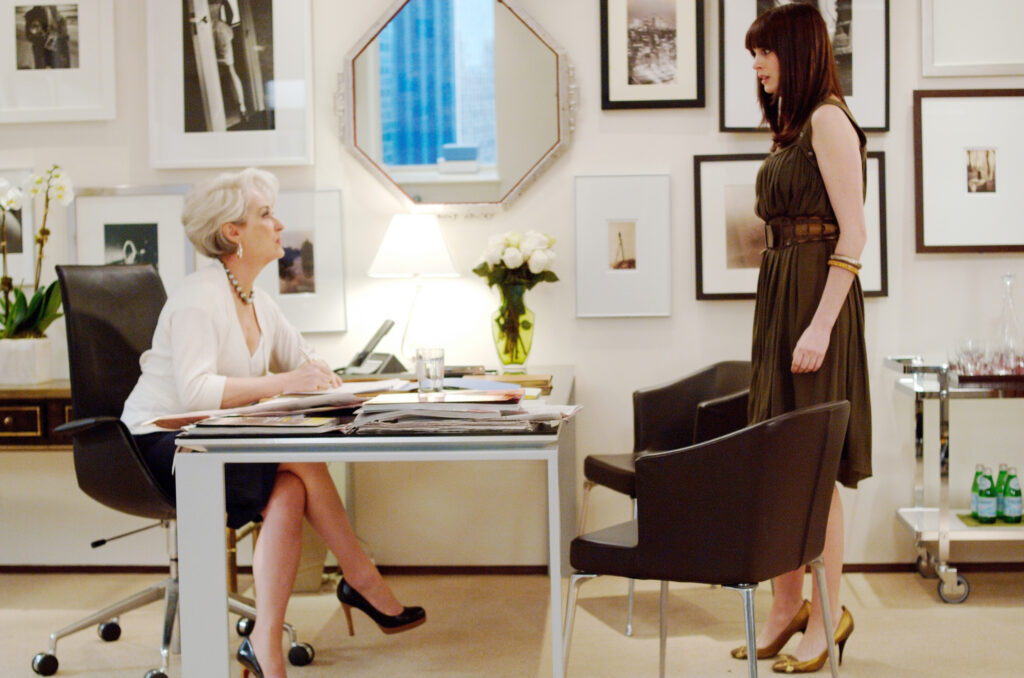
This perspective extends to its treatment of Andy’s boyfriend, Nate (Adrian Grenier). In another film he might have been the grounding, supportive presence. Here, he becomes a point of friction. His frustration with Andy’s career trajectory, and his inability to see value in it, has led many viewers to read him as the story’s true antagonist. It is a surprisingly modern lens on relationships, one that anticipates a wider rethinking of romantic tropes. Years later, films like Frozen would challenge similar assumptions more overtly, but The Devil Wears Prada was already asking those questions.
The film’s legacy is also written in the trajectories of its cast. While Meryl Streep added another iconic role to an already formidable career, both Anne Hathaway and Emily Blunt used the film as a springboard to sustained commercial success and critical acclaim. In retrospect, the casting feels less like good fortune and more like precise calibration.
What ultimately secures The Devil Wears Prada its place is not its wardrobe, but its clarity. It understands that ambition is seductive, that success often demands a trade, and that the line between adaptation and self-erasure can be difficult to see until it is crossed. For all its polish, it leaves the audience with an uncomfortable question that lingers long after the credits roll: not whether Andy made the right choice, but whether any of the available choices were ever that simple.