It’s become something of a joke by now: every time a new Avatar film is announced, the same debate bubbles up across the internet. Does James Cameron’s franchise have any lasting cultural significance, or is it just a visually stunning spectacle that will eventually fade into the ether? Then, as if on cue, the movie shatters box-office expectations, and the conversation shifts to the inevitable question: what’s next? This holiday season, Avatar: Fire and Ash hits theatres, marking the third chapter in Cameron’s epic saga. And, as always, the world waits to see whether it can continue to defy the odds.
It’s been three years since the release of Avatar: The Way of Water, and while Fire and Ash isn’t quite as distant from its predecessor as The Way of Water was to the first film, James Cameron seems well aware of the importance of refreshing the audience. Within the first few minutes, the latest Avatar entry takes the time to recap key plot points from the previous movie – an intelligent move given the sprawling narrative and vast timeline that follows. At a hefty 197 minutes, Fire and Ash is undeniably long. But whether it feels long? Well, that’s another matter entirely.
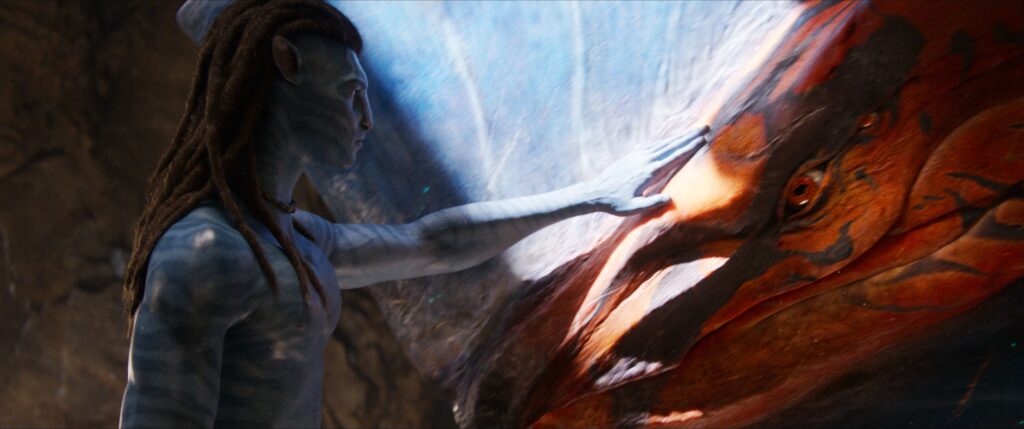
With Cameron’s mastery of scale, action, and jaw-dropping visuals, Fire and Ash is a surprisingly breezy watch despite its lengthy runtime. The film moves at a razor-sharp pace, constantly shifting gears to keep the audience engaged. This sense of momentum extends beyond just the action – it also applies to the narrative. As the film quickly develops plot points seeded in the first two entries, it never feels rushed. In fact, the most compelling aspect of Fire and Ash is its exploration of universal themes and its striking real-world parallels, reflecting a world that has changed in ways we never could have predicted.
Most notably, Avatar: Fire and Ash offers a compelling exploration of the role gunpowder – and, by extension, colonialism – has played in shaping the world. “I’m not bringing a knife into a gunfight,” Jake Sully (Sam Worthington) tells Neytiri (Zoe Saldaña), emphasising the importance of levelling the playing field with the enemy. As the stakes grow ever higher, not just in this film but across the entire series, we witness the overwhelming destruction born from humanity’s unyielding need to conquer. This mirrors the historical impact of gunpowder during the Age of Exploration, when indigenous peoples around the world, starting in the 15th century, found themselves powerless against a force too powerful to resist.

On a technical level, Avatar: Fire and Ash continues the franchise’s tradition of jaw-dropping visuals, fully utilising the IMAX 3D format for an experience that demands to be seen on the big screen. Cameron has noted that 40% of Fire and Ash is filmed in 48fps HFR (high-frame rate), a format first used over a decade ago in Peter Jackson’s The Hobbit: An Unexpected Journey. While the format faced heavy criticism back then, it works much more effectively in Fire and Ash. The higher frame rate beautifully captures the film’s breathtaking imagery – seas, mountains, and lush greenery – giving certain scenes a documentary-like quality that enhances the overall experience. While the format may still spark debate among moviegoers, it remains an interesting experiment nonetheless.
In the end, Avatar: Fire and Ash is a technical marvel, deserving of nothing less than the biggest screen possible. On the narrative front, it introduces worldbuilding concepts that are intriguing and layered. While the characters can still feel one-dimensional at times, they’re notably more fleshed out, with Saldaña’s performance standing out as the highlight. Her portrayal of Neytiri, grappling with the hate left in the wake of the previous film’s events, adds a depth that wasn’t as pronounced before. However, a particular plot convenience in the form of a new character introduced late into the movie slightly undermines the story’s emotional weight. Additionally, the film’s structure, especially its climax, feels derivative of the previous installment, echoing familiar beats and emotional moments without introducing much in the way of tension. Still, Cameron continues to prove his filmmaking prowess. While it would be refreshing to see him venture beyond the Avatar universe with his current ideas, it’s interesting to ponder what Avatar 4 and 5 will look like, should they come to fruition.